“They are breaking our hearts”: Kurdish Gypsies, identity, and social (in)cohesion
By Sarah Edgcumbe
Sarah Edgcumbe is a PhD student in the School of International Relations and a member of MECACS and Centre for Peace and Conflict Studies.
Introduction
During February and March 2023, as part of my doctoral research I spent time with a Kurdish Gypsy community in the village of Rizgari, near Dohuk, in the Kurdish Region of Iraq (KRI). My research was semi-ethnographic in nature, combining focus group discussions and semi-structured interviews with participant observation.
Rizgari is home to two Gypsy sub-clans: the majority are Hosta, while the minority are Mukri. During my research, as various intricacies regarding self-identification began to unfold, I decided to situate my research exclusively among Hosta rather than both Hosta and Mukri clans. This was largely due to my research in the KRI comprising only one element of a comparative case study. Focusing solely on Hosta narratives, actions, and experiences enabled Hosta participants to speak for themselves, and only for themselves. I felt this approach was necessary as according to the Hosta Mokhtar (mayor) and academics at the University of Dohuk, no previous research had not been conducted with either Hosta or Mukri, so it would have constituted a huge disservice to conflate the two clans for convenience. Focusing solely on Hosta thus prevented me from incorrectly generalising identities and experiences.
Identity and Nationalism among Kurdish Hosta in Rizgari
For the majority of Hosta I spoke with, a significant tension existed around labelling which was rooted in anti-Gypsy discrimination expressed by non-Gypsy society, with the exception of Yezidis who were often referred to in terms of friendship and trust. In the KRI Gypsies are referred to as “Gharraj”, a word synonymous with begging, which bears further connotations of homelessness. While the Mokhtar and well-educated Hosta community members expressed comfort with the label “Gypsy”, investing a great deal of pride in both their Gypsy identity and concurrent promotion of Gypsy rights and culture, the majority of Hosta expressed discomfort with the label “Gharraj”. They felt its negative connotations as a form of violence and pushed back against such discrimination by self-identifying as Hosta – a word which points to their history or craftsmanship and working with their hands.
Whereas the majority of Romani Gypsies (“Domari” in the Middle East) are said to share an origin story which traces back to Northern India,[i] Hosta in the KRI have a different origin story. The Mokhtar, while explaining to me his assertion that “Gypsies are the original Kurds”, traced Hosta (and broader Kurdish Gypsy) lineage back to the Mukriyan principality (14th – 19th century) in what is now Kurdish Iran. Reflecting this, the overwhelming majority of Hosta who participated in my research identified first and foremost as Kurd, then secondarily as Hosta. The only exception to this rule was a handful of women who identified primarily as women or mothers, then Kurd and Hosta afterwards.
Hosta support for Kurdish ideology and nationalism is unwavering. They are extremely proud of their Kurdish identity which represents a sense of brother and sisterhood cultivated through shared experiences of persecution, hardship, and struggle. Hosta were targeted by Saddam Hussein and his forces to the same degree as other Kurds, subsequently fleeing to Turkey and battling to survive the elements alongside the broader Kurdish displaced population. More recently, when ISIS occupied Mosul in 2014, many Hosta men voluntarily joined the Peshmerga[ii] on the frontlines. Fifteen Hosta men from Rizgari were martyred during the conflict.
The Hosta participants I spoke with were extremely proud of the role their community members played in the fight against ISIS. For them, there was never a question as to whether the men would join the Peshmerga; one Hosta man who had fought ISIS stated simply during a focus group, “we have to fight because it is our land. We have to fight for it.” In this instance, Hosta men were simply fighting for Kurdistan side by side with other Kurds. Succinctly illustrating a strong Kurdish identity and support for Kurdistan, was the answer one eighteen-year-old Hosta youth provided when I asked what peace looks like for him. Without any pause for thought he responded, “the Kurdish flag is the picture of peace for me.”

Stereotypes, structural violence, and social (in)cohesion
Because of their strong Kurdish identity and the fact that they have stood side by side “with Kurds through everything”, the emerging hierarchy of Kurdishness, or of Kurdish citizenship which Hosta are now experiencing has been absorbed as a bitter betrayal by many in Rizgari. Though protected from overt violence in the post-Saddam KRI, the contemporary socially constructed Iraqi Kurdish hierarchy has failed to elevated stigmatised ethnic and ethno-religious groups to the same status as majority Kurds. Instead, social discrimination, neoliberalism, and structural violence have converged to actively maintain the subordinance of certain groups. For example, at the very bottom rungs of the hierarchy sit Yezidis and Gypsies, each stigmatised for different reasons by majority Kurdish society. Gypsies however, inhabit the lowermost rung. Largely unable to participate in consumer society, frequently non-literate, and in the case of Rizgari – subjected to inadequate living conditions, Hosta are often unable to obtain ‘respectable’, or well-paying jobs.
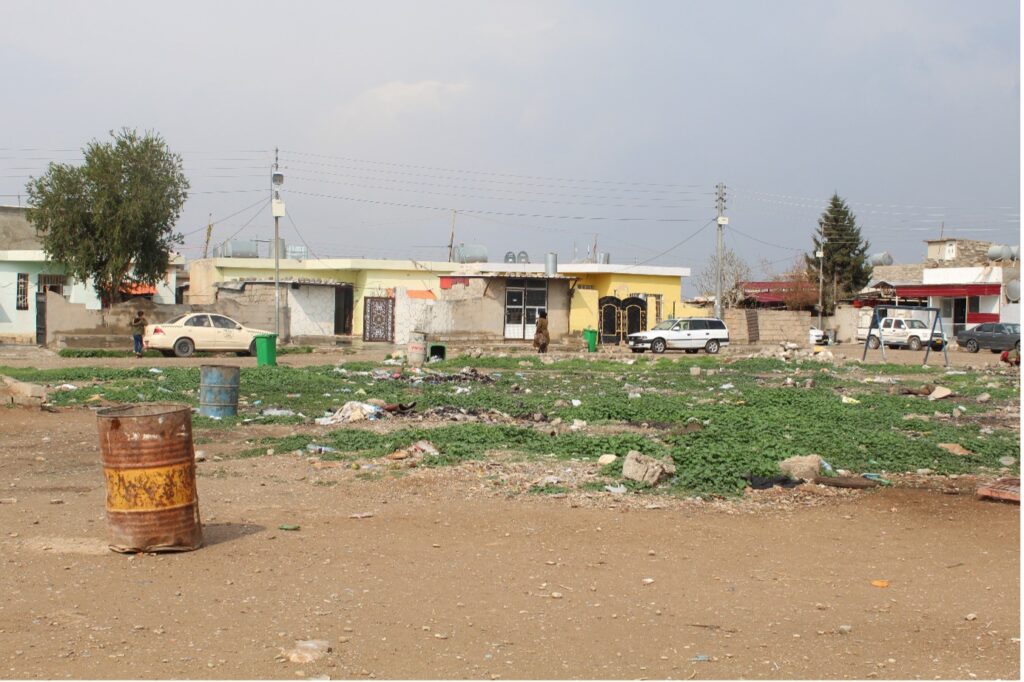
Rizgari itself was constructed by the Ministry of Construction and Housing in 2008. It was built specifically for the most socio-economically deprived Gypsies in Dohuk Municipality, who at the time were living in tents and rudimentary houses constructed from mud. Unlike other neighbourhoods and villages, and unlike the refugee camp which sits next door, Rizgari does not have paved streets or a health clinic. Most importantly for village residents, education provision for the approximately 1,500 Hosta and Mukri children is completely inadequate. Residents of Rizgari are keenly aware that other towns and villages have access to these integral resources and means of community development. Many interpret such differential treatment as evidence that the government perceives them to be “inferior Kurds.” Contrary to their strong sense of Kurdish identity and belonging to the land, as one Hosta man told me, such treatment “makes me feel like I’m not Kurdish – like I’m a foreigner here.”
There is in an entrenched narrative among non-Gypsy society in the KRI that Gypsies beg out of choice – that they are misleading the public in doing so because they have a lot of cash hidden at home. According to this trope, Gypsies enjoy living in sub-standard living conditions, and embrace an uncivilised, or dirty, lifestyle. People point to famous Gypsy musicians and singers as evidence of this, often saying something along the lines of “See! That Gypsy singer has integrated! All Gypsies can do this, they just choose not to!” Such a commentary completely overlooks the insidious and disproportionate degree of structural violence which blights the everyday lives of the residents of Rizgari. Shanar, a Hosta woman who used to beg when her son was an infant, counteracted this narrative, asserting that Hosta beg only out of sheer necessity and desperation. Shanar herself experienced a deep sense of shame when she was begging, and was often subjected to negative comments and poor treatment: “Sometimes they would say that I’m doing it for nothing because I’m just a Gypsy – they called me a liar and called me a Gypsy.” Shanar seemed to be experiencing some trauma as a result of her experiences begging, as she described feeling sensations of anxiety whenever she had to leave Rizgari, and particularly when she was in Dohuk due its distance from the village. She explained, “no matter how good you are or how bad you are, when you go outside [of Rizgari] they will just think you are bad because you are a Gypsy.”
Among research participants, younger generations (both men and women) spoke most openly about experiencing negative treatment from majority Kurds. Correspondingly, it was also the younger generations who prioritised eradication of discrimination and hate speech in their conceptualisations of peace. However, such sentiments were not exclusive to the younger generations, as only older men stated that they had never experienced poor treatment by non-Hosta. Meanwhile, all participants recognised differential governmental treatment of Hosta compared to other ethnic groups in terms of community development and provision of resources and services.
Peacebuilding Strategies for whom?
During a focus group, Sozan, an older Hosta woman said sadly, “they [other Kurds] call us bad things, but we never call anybody bad things because we know how it feels. They are breaking our hearts… We respect them a lot, but they do not respect us in return.” In response, another older woman added, “Even though they curse at us, we respect and love other Kurds.”
Hosta from Rizgari must navigate a social positionality which has been imposed upon them by both governmental institutions who have failed them, and majority society which stigmatises and “others” them unless they conform to the “good Gypsy” image and establish themselves as musicians or singers. Meanwhile, poverty and structural violence remains unacknowledged despite the huge obstacle it presents for social cohesion.
[i] Matras Y, I Met Lucky People: The Story of the Romani Gypsies, 2015, pp14-15; Le Bas D, The Stopping Places: A Journey Through Gypsy Britain, 2018, p6.
[ii] Iraqi Kurdish military forces. ‘Peshmerga’ translates as ‘those who face death.’